Why Is My Hair Thinning? An Objective Guide to Female Hair Restoration
Hair thinning is a common but often unaddressed concern for many women. Whether you are noticing increased shedding in your brush, a widening part, or a general reduction in volume, navigating hair loss can be distressing. At Eydis Aesthetics, our goal is to provide objective medical guidance and evidence-based treatments to help you address these physical changes.
A Clinical and Empathetic Approach
Dr Charlotte Ying, our cosmetic surgery practitioner, approaches female hair loss with both clinical expertise and personal understanding, having navigated her own experiences with hair thinning. At our Sydney clinic, we prioritise patient education and clinical safety. Dr Ying has personally evaluated the clinical efficacy of the hair restoration treatments we offer to ensure they meet our strict medical standards. During a consultation, you will receive a thorough medical assessment in a supportive, female-led environment.
The Mechanics of Hair Growth and Loss
Hair growth cycle
To understand how our restoration treatments work, it is helpful to look at how human hair naturally grows. Your hair follicles constantly cycle through specific stages: an active growth phase (Anagen) lasting 2-8 years, a transition phase (Catagen) lasting about 2-3 weeks, and a resting phase (Telogen) lasting about 3 months before returning to the Anagen phase. You can see a visual representation of this cycle in the image below.
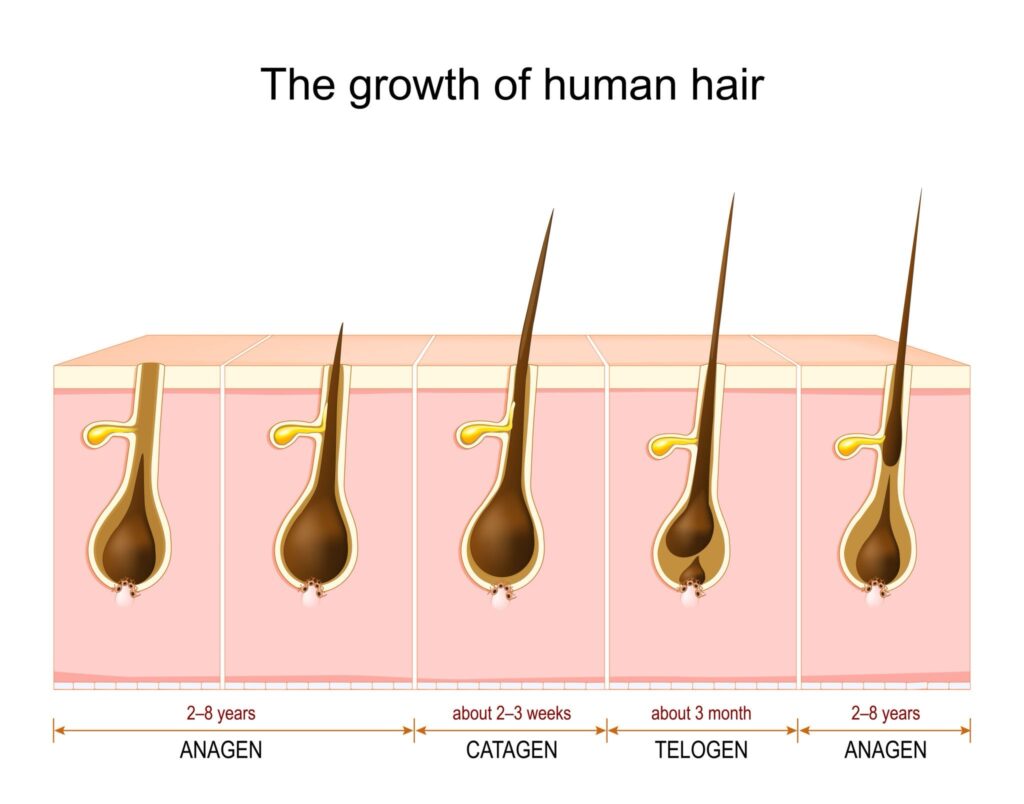
Hair loss often occurs when this cycle is disrupted. For women, this disruption is frequently associated with:
-
Hormonal Fluctuations: Physiological changes such as pregnancy, menopause, or conditions like polycystic ovary syndrome (PCOS) can trigger significant follicular shedding.
-
Telogen Effluvium (Stress-Induced Hair Loss): Major physiological stressors, illness, or surgical interventions can prematurely push a large number of hair follicles into the resting phase all at once.
-
Androgenetic Alopecia (Female Pattern Hair Loss): A genetic condition that typically presents as a gradual widening of the part and thinning at the crown of the head.
-
Nutritional Deficiencies: Inadequate levels of iron, vitamin D, or B vitamins can impact follicular health and disrupt normal hair production.
Clinical Treatment Options at Eydis Aesthetics
Because female hair loss is multifactorial, a highly individualised approach is necessary. Dr Charlotte Ying develops customised treatment plans tailored to address the specific cause of your hair loss, utilising advanced clinical therapies and surgical restoration methods.
Exosome Therapy with Medical Microneedling
For patients seeking non-surgical scalp treatments, exosome therapy offers an advanced clinical option. Exosomes are cellular messengers that deliver specific growth factors to target tissues. We pair highly concentrated exosome serums with medical microneedling. The microneedling device creates controlled micro-channels in the scalp, which stimulates the body’s natural healing cascade—increasing blood flow to the area—and allows the exosome serum to absorb deeply into the follicular environment. This treatment aims to support follicular function, reduce localised inflammation, and encourage healthier hair growth.
Platelet-Rich Plasma (PRP) Therapy
Platelet-Rich Plasma (PRP) therapy is an autologous treatment, meaning it utilises the healing properties found in your own blood. During this procedure, we draw a small blood sample and centrifuge it to isolate the nutrient-rich plasma. This concentrated plasma is then carefully administered into the thinning areas of the scalp via micro-injections. The goal of PRP is to deliver your body’s own concentrated growth factors directly to the hair follicles, supporting tissue repair and stimulating new growth.
Follicular Unit Extraction (FUE) Hair Transplantation
For more advanced stages of hair loss where follicles are no longer active, surgical transplantation may be the most appropriate clinical pathway. As an Australian-trained practitioner performing cosmetic surgeries, Dr Ying is experienced in the Follicular Unit Extraction (FUE) method, specifically utilising the NeoGraft® system.
Unlike older transplant techniques that can leave a linear scar across the donor site, FUE is a precise, minimally invasive surgical method. Dr Ying extracts individual, healthy hair follicles from a dense donor area and meticulously transplants them into the areas of thinning. This approach aims to restore density and achieve a natural-looking integration with your existing hair while supporting an efficient postoperative recovery.
Your Pathway to Hair Restoration
Addressing hair loss begins with a proper medical evaluation to determine the underlying cause and the most appropriate course of action. You do not have to guess which treatment is right for your anatomy.
If you are ready to explore your clinical options for hair restoration, we invite you to book a consultation with Dr Charlotte Ying at Eydis Aesthetics. You will be met with objective medical advice and a customised treatment plan designed to address your specific anatomical needs.
Any surgical or invasive procedure carries risks. Before proceeding, you should seek a second opinion from an appropriately qualified health practitioner. Outcomes and recovery times vary between patients.

PLEASE NOTE
Any surgical or invasive procedure carries risks. Before proceeding, you should seek a second opinion from an appropriately qualified health practitioner.